



BlogGrowth
More Stores Should Mean More Revenue — Not More Work
Most distributors hit a ceiling — not because they run out of clients, but because every new store adds more admin. Here's how to break the linear scaling trap.

More stores should mean more revenue. Not more work.
That's the promise of on-demand. You build a store for a client. Orders come in. Products get decorated and shipped. Revenue grows. You build another store.
But most distributors hit a ceiling — not because they run out of clients, but because every new store means more order routing, more artwork chasing, more fulfillment coordination. The work scales linearly. The revenue doesn't.
The Linear Scaling Trap
Here's what the typical growth path looks like for a distributor managing on-demand stores:
5 stores — manageable. You know every order. You personally forward POs to decorators. You chase artwork approvals over email. It works.
15 stores — getting busy. You start missing details. A wrong size here, a delayed proof there. You hire someone to help manage fulfillment. Your overhead just went up, but your per-store revenue didn't.
30+ stores — you're the bottleneck. Every new client means another inbox to monitor, another decorator relationship to manage, another set of artwork files to prep. Your account executives want to sell more, but the back office can't keep up.

The problem isn't demand. It's that every manual touchpoint in the fulfillment chain gets multiplied by the number of stores you operate. Ten stores with eight manual steps each is eighty things that can go wrong every week.
Why Traditional Tools Don't Fix This
Most distributors try to solve the scaling problem with more people or better project management. Neither works long-term.
Hiring more operations staff increases your fixed costs. Your margin per store shrinks. You need even more stores to justify the overhead — which creates even more work. It's a treadmill.
Project management tools (spreadsheets, Trello, shared inboxes) organize the chaos but don't eliminate it. You're still manually routing orders, still chasing artwork approvals, still re-keying data between systems. You've made the busywork tidier. You haven't removed it.
The root cause is structural: if a human has to touch every order between "customer clicks buy" and "product ships," then your throughput is capped by the number of humans you can afford.
What Changes When the Workflow Is Automated
The unlock isn't working harder or hiring more. It's removing the manual steps entirely.
On Brikl, the workflow from order to shipment is fully automated:
- Customer places an order on a branded storefront.
- Artwork is already production-ready — logos are pre-configured with decoration method, placement, and color at the catalog level. No proofing round. No back-and-forth.
- The order validates and routes automatically to the correct fulfillment partner based on product type, decoration method, and shipping destination.
- The decorator receives a clean, production-ready job — not a forwarded email with a PO attachment. A structured order with validated sizes, pre-separated artwork, and shipping labels.
- Payment is collected at checkout — Brikl is the Merchant of Record. Sales tax is calculated, collected, and filed. You don't invoice. You don't chase.
- Your profit pays out automatically on a regular schedule via Stripe.
The distributor's role in this flow? Build the store. Set the markup. Share the link. Everything after that runs without them.
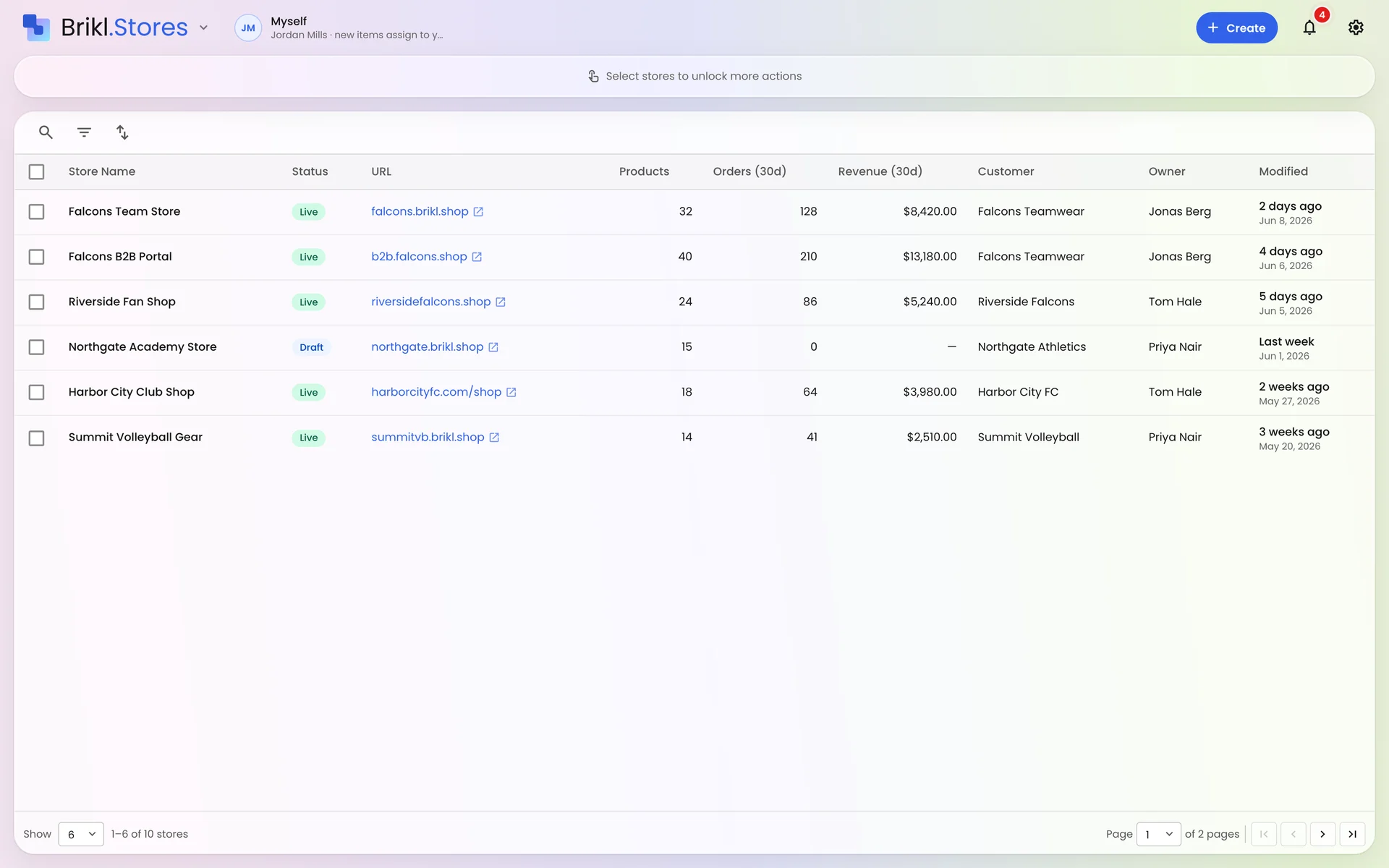
The Math Changes
When the per-store operational cost drops to near zero, the economics flip:
- Store #1 takes the most effort — choosing products, uploading logos, configuring the storefront.
- Store #2 is faster — you duplicate the catalog and customize.
- Store #10 is trivial — you have templates, you know the flow.
- Store #50 requires the same operations team as store #10.
That's the difference between linear scaling and leverage. Your revenue grows with each new store. Your workload doesn't.
The Real Ceiling Isn't Clients — It's Architecture
If your current setup requires a human to route every order, prep every art file, and chase every payment, then you have a structural ceiling. No amount of hustle moves it.
The distributors who are scaling past 30, 50, 100+ stores aren't working harder. They're running on infrastructure that removes the manual layer entirely — so their account executives can keep selling without the back office becoming the bottleneck.
The question isn't "how do I manage more stores?" It's "why am I managing them at all?"
Ready to remove the bottleneck? Start free on Brikl — no credit card, no monthly subscription. Just 3.5% when you sell.
More from the blog

Growth
Coupons That Actually Move Merch
A coupon code is more than a discount — it's a reason to buy now. Here's how to use percentage and fixed-amount coupons to launch drops, reward audiences, and clear seasonal merch.

Growth
Why Personalization Matters for Promotional Product Distributors
Team stores, corporate programs, and school spirit shops all share one need: every item should feel like it belongs to the person wearing it. Without built-in personalization, distributors lose hours to spreadsheets, typos, and re-keyed orders. Here's why personalization belongs inside the product on Brikl, not in an inbox.

Growth
The Fastest Way to Launch On-Demand Stores
From blank page to live, branded storefront in roughly 22 minutes — without inventory, without bulk minimums, and without writing a single line of code.