



BlogOperations
One Store Per Department: Running Multi-Team Merch With Sub-Organizations
Big organizations don't need one giant merch store — they need many small ones that stay on brand. Sub-organizations give every department its own store while central admins keep control.

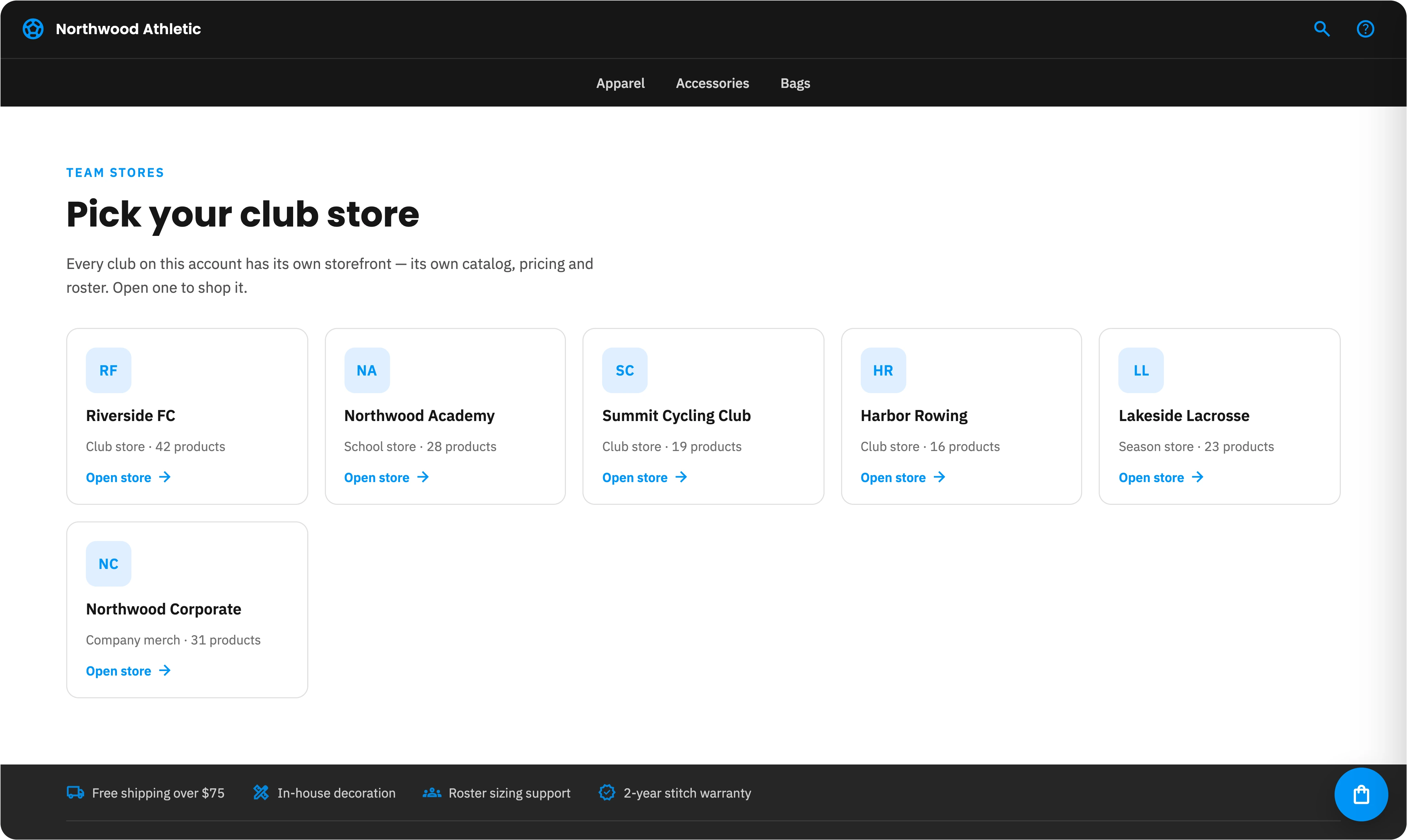
When a large organization asks for a merch store, what they usually mean is several stores. A hospital wants a different store for each department. A university wants one per college, team, and alumni group. A franchise wants one per location. An enterprise wants separate stores for HR gifting, events, and new-hire kits.
Try to serve that with a single mega-store and it falls apart fast — the catalog gets bloated, the wrong people see the wrong products, and no one owns their piece. The right structure is many focused stores under one roof. That's what sub-organizations are for.
The problem with one big store
A single store forces every group into the same catalog, the same branding, and the same permissions. A department that only needs five items has to wade through hundreds. Reporting mixes everyone together. And if one team wants its own look or its own fundraiser, there's nowhere clean to put it.
Multi-team organizations don't have one merch program. They have many — and they need each one to feel purpose-built.
How sub-organizations work
Sub-organizations let you separate stores, catalogs, and team members by client, division, department, or location — each isolated, all under one parent account.
- Each unit gets its own store with its own products, pricing, and branding.
- Data and permissions stay separated, so a department admin only touches their own store and only sees their own orders.
- The parent admin keeps central control — brand standards, oversight, and reporting across every store from one dashboard.
You get the autonomy of many stores with the governance of one account. Every plan supports unlimited organizations, so the structure grows with the org.
Where it fits
- Healthcare systems — a store per department for staff apparel and gear, with fundraisers where they're needed.
- Universities and schools — separate stores for colleges, athletics, faculty, and alumni, each on brand.
- Franchises and multi-location businesses — one store per location, managed centrally by the franchise admin.
- Enterprises with multiple office locations — a store per office or region so each site manages its own swag, while a central admin controls branding and approvals across every location.
Central brand control, local flexibility
The reason this works for big organizations is that it solves both halves of the problem at once. Local teams get a store that's actually theirs — right products, right branding, their own orders. Central teams get to lock brand standards and see the whole picture. Nobody has to choose between control and flexibility.
And because everything runs on-demand, none of it requires inventory. Each department's store produces only what's ordered and ships directly to the buyer — so a fifty-store organization carries exactly as much stock as a one-store organization: none.
If you're scoping a multi-department or multi-location program, that's the model to build on. See how it applies to corporate merchandise programs, or book a walkthrough to map it to your structure.
More from the blog
Operations
On-Demand Isn't About Minimums — It's About Eliminating Every Manual Touchpoint
The industry equates on-demand with no minimums. But the real breakthrough is end-to-end automation — and the minimum of 1 is just a byproduct.
Operations
The Real Cost of Selling Promo: A Margin Breakdown
A transparent breakdown of what it actually costs to sell promotional products on-demand — with real numbers, real fees, and real profit margins.