



BlogGuide
Running a Club or Team Store Without Bulk Orders or Box Logistics
Sports clubs have been running kit orders through spreadsheets and bulk orders for years. Here's how clubs are switching to on-demand stores where every player orders their own size.
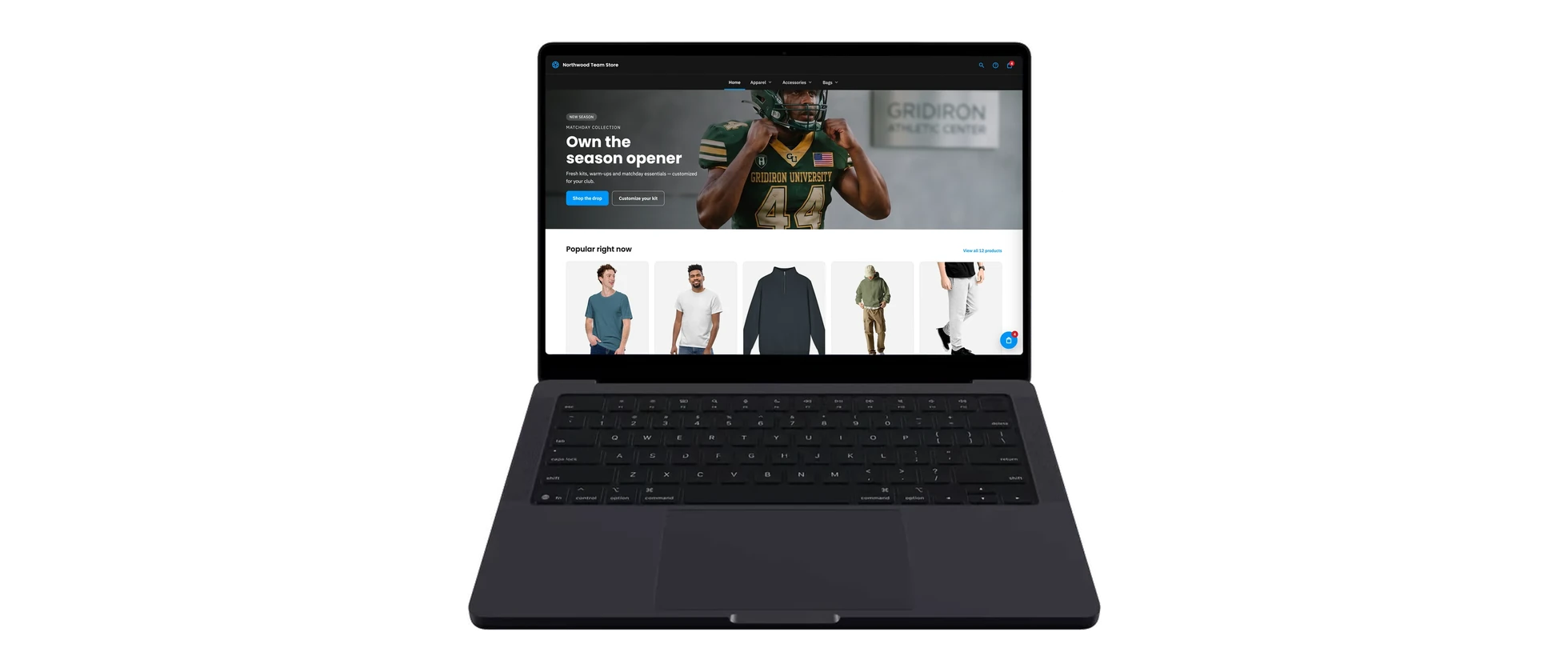
A club can run an always-on team store where every player orders their own size on demand — no spreadsheets, no bulk order, no box logistics. On Brikl, each order is produced per item and shipped to the family, with a percentage back to the club. See youth & club sports stores and spiritwear & teamwear stores on Brikl.
In short:
- Brikl runs an always-on team store; players and parents order their own gear on demand.
- Brikl produces each order per item — no pre-season bulk buy and no leftover stock.
- A percentage of every Brikl order can go back to the club.
Every club administrator knows the spring kit order. Someone sends a spreadsheet. Parents fill in sizes. Half the forms come back late. You compile everything, send a bulk order to the decorator, wait three weeks, pick up the boxes, sort by player, and hand out items at practice — only to find that two medium hoodies are missing and someone put down the wrong size for their kid.
This is how clubs have been running kit for years. It doesn't have to work this way.
What does on-demand kit ordering look like?
On Brikl, a sports club runs a permanent online store — on its own domain, with its own branding — where players and families order exactly what they need, in their size, when they need it.
No spreadsheet. No bulk order. No minimum quantity. No box-sorting logistics. Each order ships directly from the fulfillment partner to the player's door.
The club sets up the store once: approved products, locked-in club colors and logos, pricing. That store stays live year-round. New members who join mid-season can order kit immediately. Players who outgrow their hoodie in November can buy a new one without waiting for a spring order window.
Who runs stores on Brikl
Club administrators use it to eliminate the logistics burden of managing bulk orders. The store runs; orders come in; fulfilment happens automatically. The admin sees a dashboard, not a box of shirts.
League commissioners use it to create a centralized merchandise program across multiple teams. One account, stores for every team in the league, with per-team branding and per-team catalog control.
Coaches use it to offer their squad team-branded training gear without having to manage procurement themselves. Share the link, players order their own size, done.
Team parents use it when they want to outfit families — matching supporter scarves, parent hoodies, sibling tees — without committing to quantities upfront. The store is always open; parents order when it makes sense for them.
Multi-sport operators — clubs running football, basketball, swimming, and athletics under the same umbrella — use Brikl's sub-organization structure to give each sport its own store with its own kit catalog while the club director sees everything from one account.
One club, many stores
Brikl supports a parent-account structure that's well-suited to how sports clubs actually operate. The club account holds individual stores for each team, sport, or program — each with its own branding, its own product catalog, and its own admin access.
The club director sees all stores. The U16 team manager sees only the U16 store. Brand standards — approved logos, mandatory color codes — can be set at the club level and locked so individual teams can't go off-brand.
For multi-club leagues or federation-level programs, the same structure scales: one top-level account, clubs underneath, teams under clubs. Administrators at each level see only what they're responsible for. Learn more about how sub-organizations work in Brikl.
Decoration methods for sports
Different sports call for different decoration. Football match kits need sublimation — the printing process that makes colors vivid and holds up through a season of play and washing. Training tees and casual fan gear often work in DTG (direct-to-garment) or screen print for bold graphics at a lower per-unit cost. Club crests on hoodies and quarter-zips land better in embroidery — it reads as premium and doesn't crack over time. Player names and numbers on jerseys need heat transfer vinyl to stay readable through hard use.
On Brikl, products using different decoration methods can all live in the same store. A kit order that includes a sublimated match jersey, an embroidered training hoodie, and a screen-printed supporter tee goes through one checkout. Orders route automatically to the right fulfillment partner.
Pre-order drops and seasonal launches
Some clubs prefer to run seasonal kit drops rather than a permanently open store — a defined ordering window for the spring season, followed by on-demand availability for the rest of the year.
Brikl supports both. You can open a store for a defined campaign window (players order by March 15, production batch ships April 1) or keep it open year-round with on-demand fulfillment. Many clubs do both: a seasonal pre-order for core kit, plus an always-on store for casual fan gear, training accessories, and replacement items.
Moving from the spreadsheet-and-bulk-order model
The switch is mostly about changing the process, not the products. Your decorator or fulfillment partner relationship moves onto the Brikl platform. Your logos and color specs carry over during setup. Your existing product selection — club hoodies, training tees, match jerseys — gets configured in the store.
What changes: the coordinator isn't the bottleneck anymore. Players order directly. Orders fulfill directly. The coordinator gets reports, not boxes.
Getting started
Brikl is free to start. No setup fee, no monthly subscription. Build the store, set your kit catalog, share the link at the season kickoff.
Explore the sports clubs page for a full overview, or start a free account and have a test store live before your next training session.
More from the blog
Guide
Setting Up an Internal Company Store, Step by Step
An internal company store lets employees order their own branded gear on demand. Here's the setup, start to finish, with no inventory and no developers.
Guide
What Does an Employee Swag Store Cost, and How Long Does Setup Take?
An employee swag store shouldn't need a budget line or a project plan. Here's what it costs to run one on demand — and how fast it goes live.
Guide
How Creators and Influencers Earn From a Branded Merch Store
Your audience already wants to represent you. A branded merch store turns that into revenue — with no inventory, your own margin on every sale, and coupons to launch the drop.