



BlogGuide
Flat vs. Percentage: How to Run a Merch Fundraiser That Scales
A merch fundraiser can raise a set dollar amount per item — or a percentage of the price that scales with every sale. Here's when to use each, and how to run a drive that funds itself on demand on Brikl.

Merch is one of the easiest ways for a school, team, club, or nonprofit to raise money — people are happy to buy something they'll actually wear when a portion supports the cause. The question is how you set the amount raised on each sale. On an on-demand store, you have two options, and picking the right one matters more than most people expect.
The two modes
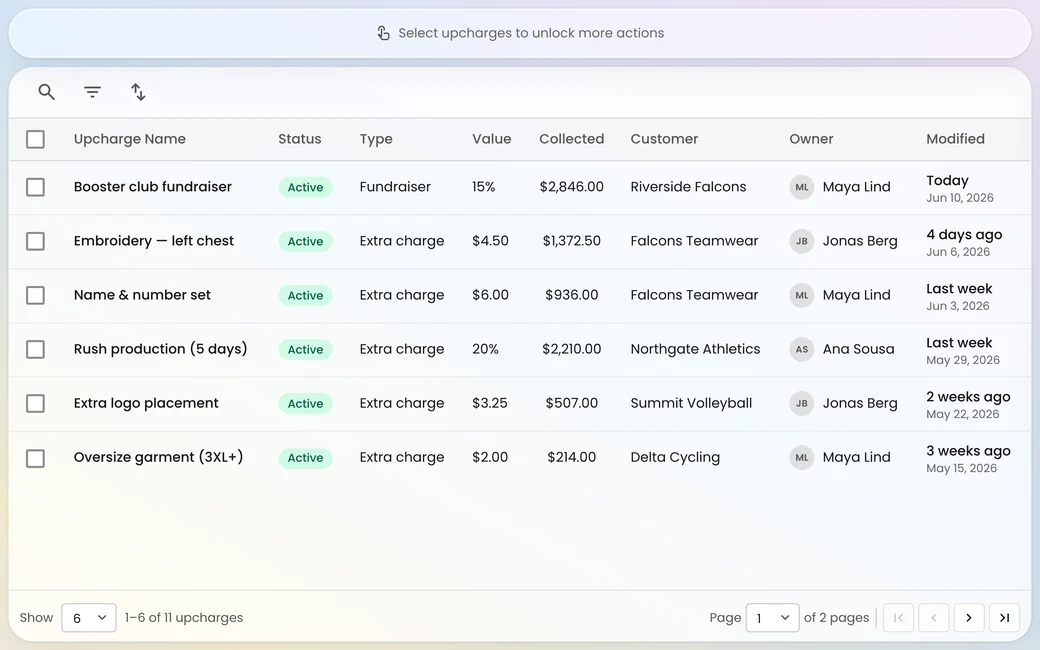
When you build a fundraising campaign, each affected item, product, or variant gets a set-aside — the portion of the sale that goes to the cause. That set-aside can be:
- A flat dollar amount — for example, $5 added to each item, whatever the item costs.
- A percentage of the price — for example, 15% of each item, so a $60 hoodie contributes more than a $25 tee.
Same tool, two very different outcomes.
When to use flat
A flat amount is simple and predictable. Everyone contributes the same, and it's easy to communicate: "$5 from every item goes to the team." It works well when your catalog is priced in a tight range, or when you want a clean, round number that's easy for buyers to understand.
The tradeoff: flat treats a premium jacket and a basic tee identically. If your store spans a wide price range, a flat set-aside can feel too small on the high-value items and too heavy on the cheap ones.
When to use percentage
A percentage scales with the order. Higher-value items and bigger carts raise proportionally more, automatically — no need to hand-tune each product. It keeps the contribution fair across a mixed catalog, and it means your best sales days are also your best fundraising days.
Percentage is the better default when you're selling a real range of products, or when you want the drive to grow naturally as buyers add more to the cart.
A quick example
Say you sell a $25 tee and a $60 hoodie in the same store.
- Flat $5: the tee raises $5 (20%), the hoodie raises $5 (about 8%). Buyers of the pricier item contribute a smaller share.
- Percentage 15%: the tee raises $3.75, the hoodie raises $9. The contribution tracks the price, and a full cart raises more.
Neither is "right" — but they behave differently, and now you can choose on purpose.
Everything else a fundraiser can do
The flat-vs-percentage choice sits inside a fuller toolset:
- Set a target and track progress in real time as orders come in.
- Run multiple campaigns at once in the same store, each on its own items and goal.
- Time-limited drives with a start and end date for events, seasons, or galas — switch on or off anytime.
And the same mechanism powers more than charity: spiritwear kickbacks, booster clubs, nonprofit drives, creator earnings, and sales-rep commissions all run on it.
Because it's all on-demand, there's no upfront cost and no inventory — the store produces exactly what's ordered, and the set-aside is calculated automatically on every sale.
Ready to set one up? See how fundraising works, or explore stores for nonprofits and associations.
More from the blog
Guide
Self-Service Swag Ordering for Employees
The office manager shouldn't be the swag department. Self-service ordering lets employees get what they need without a request, a form or a bulk buy.
Guide
Setting Up an Internal Company Store, Step by Step
An internal company store lets employees order their own branded gear on demand. Here is the setup, start to finish, with no inventory and no developers.
Guide
What Does an Employee Swag Store Cost, and How Long Does Setup Take?
An employee swag store shouldn't need a budget line or a project plan. Here's what it costs to run one on demand, what you don't pay for, and how fast it goes live.