



BlogGrowth
On-Demand Stores: Residual Income for Distributors Heading Toward Retirement
You spent decades building client relationships. Slowing down shouldn't mean handing them off or walking away from the income they generate.

On-demand stores let a promotional products distributor keep earning from existing client accounts while doing far less of the day-to-day work. On Brikl, each client gets a branded store. Their people order whenever they need something, every order is produced and shipped on demand, and Brikl handles payment, sales tax and order service. The distributor earns the margin on each sale and spends their time on relationships, not purchase orders.
In short:
- Many distributors heading toward retirement want to keep the accounts and the income, but not the order-desk work.
- An on-demand store turns a client from a series of projects you quote and chase into a channel that orders on its own.
- On Brikl, there is no inventory, no minimum order quantity and no invoicing; Brikl acts as Merchant of Record.
- You set your own price on every item, so the margin on each order is yours.
- Stores keep taking orders on evenings, weekends and holidays — including the weeks you're not working.
What does residual income look like for a promo distributor?
Residual income is revenue that keeps coming in from work you've already done. For a distributor, that work is the client relationship: the trust, the logo files, the knowledge of what the team actually wears.
In the traditional model, that relationship only pays when you act on it. Every order starts with a call, a quote, a proof and a PO. If you stop making calls, the income stops too. With an on-demand store, the relationship is set up once as a store, and the client's people keep ordering from it. You still own the account. You just no longer have to touch every order.
Why doesn't the order-desk model work when you slow down?
Because in the order-desk model, your income is tied to your hours. Cut the hours and the revenue goes with them.
A typical bulk order involves collecting sizes, quoting, chasing approval, placing the PO, following up with the decorator, invoicing and handling the one box that arrived with the wrong color. That work doesn't shrink because you want to work three days a week instead of five. Clients also notice when response times slip, and a competitor is always one email away.
Order-desk model vs on-demand stores
| Order-desk model | On-demand store on Brikl | |
|---|---|---|
| How an order starts | You quote, chase approval and place a PO | The client's people check out in their store |
| Your time per order | Hours, from quote to delivery | None for standard orders |
| Inventory and minimums | Bulk buy, often with leftover stock | No inventory, no minimum order quantity |
| Payment and sales tax | You invoice, collect and remit | Brikl collects payment and handles sales tax as Merchant of Record |
| Order status questions | Come to you | Tracking emails go to the buyer automatically |
| When you take time off | Orders wait, or go elsewhere | The store keeps taking orders |
How do on-demand stores generate residual income on Brikl?
You build a branded store for each client, set your price on each item, and share the link. From then on, orders flow without you.
When someone orders, the order, the decoration details and the high-resolution artwork route automatically to a decoration partner based on the product and decoration method. Production takes 2–5 business days for DTG and DTF printing and 3–7 for embroidery, and most domestic orders arrive within 7–10 business days. Status updates flow back to your dashboard, and the buyer gets a tracking number by email when the order ships.
The store draws on 8,000+ products from 190+ brands, so a client can carry anything from polos and jackets to drinkware and signage. Payouts land in your bank account through Stripe. On the Launch plan, Brikl charges 3.5% per transaction, with no setup fee and no monthly subscription, so a quiet month costs you nothing. See how it works for the full order flow.
Why this works for a book of existing clients
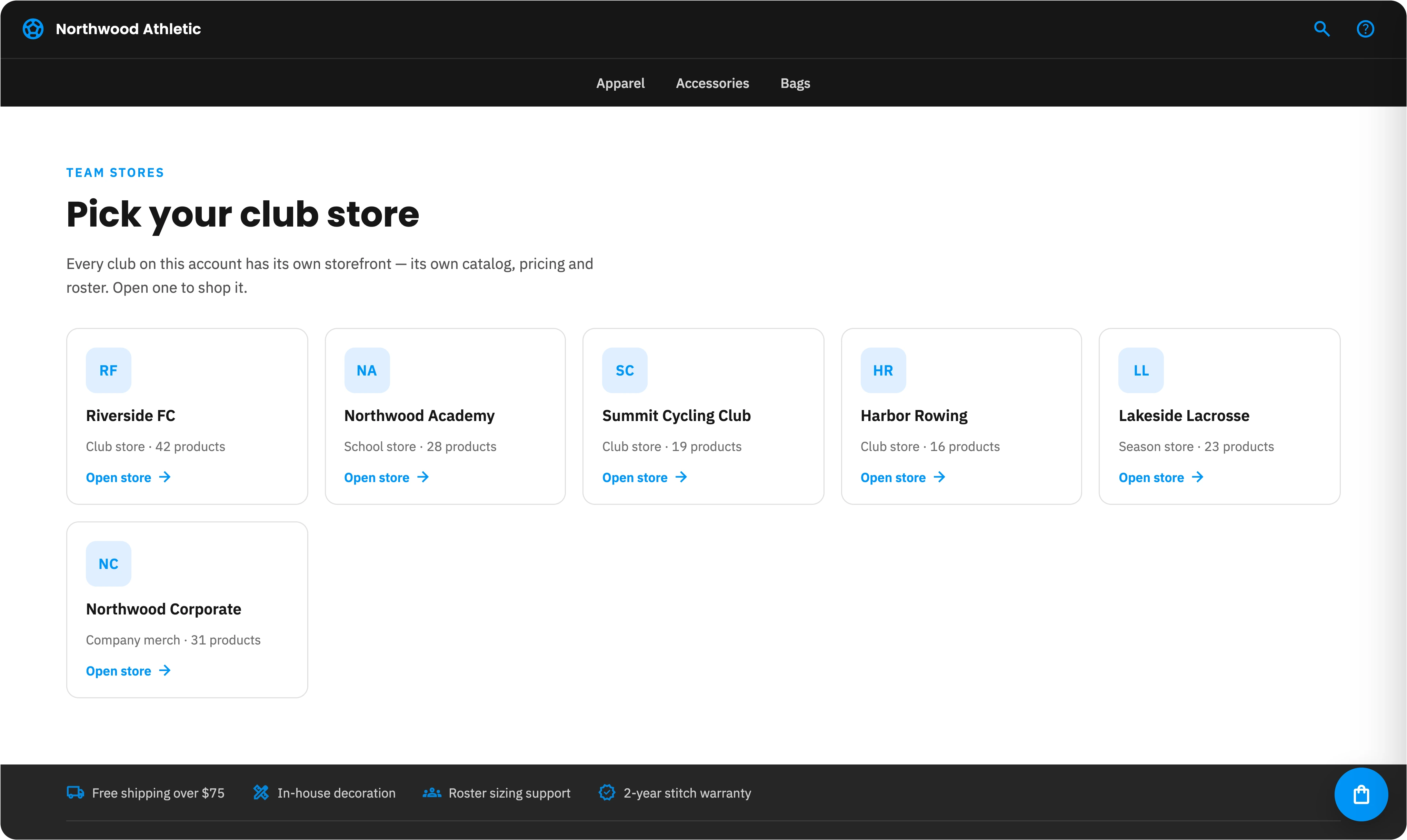
You already have what new distributors spend years building: clients who trust you and logos on file. Brikl lets you run unlimited stores, each with its own address, catalog and branding, and each client sees only their own store and pricing. One relationship can even become several stores — one per location, department or event.
What could this look like in practice?
Picture a hypothetical distributor with 30 years in the business and a dozen loyal accounts: a brewery, two dental practices, a high school booster club, a few contractors and a local bar and grill.
Over a few months, each account gets its own store. The brewery sells staff shirts and taproom merch to customers. The booster club runs a spring and fall store with a fundraiser built in. The contractors' crews order their own workwear in their own sizes. The distributor checks the dashboard a couple of times a week, refreshes stores with seasonal products, and spends the rest of the time on the clients themselves — lunches, ideas, the next store.
Brikl's illustrative example: say those 12 stores average $1,200 in sales each per month, or $14,400 in total. With a 75% markup on the cost of goods, a common setting for distributors, about 43% of every sale is margin. That is roughly $6,170 a month, with no inventory bought up front. Brikl's 3.5% transaction fee on those sales is $504. Payment processing is separate, at 2.9% + $0.30 per transaction in the US. Your own numbers depend on your pricing and your clients, but the principle holds: the stores keep selling whether you worked that week or not.
The pitch to the client is just as simple. A store costs them nothing to set up, they never have to collect sizes again, and they can earn a share of every sale through a built-in fundraiser. If you need one more reason for them to say yes, offering the store at no cost to them is usually enough.
What changes about your week?
You stop running orders and start managing accounts. The parts of the job you enjoy stay; the admin goes.
- What Brikl takes off your plate: placing POs, chasing decorators, invoicing, collecting payment, sales tax, order status questions and customer service on orders.
- What stays with you: the relationship, choosing the product range for each client, seasonal refreshes, and spotting the next store — a new location, an event, a team.
- What you can now do: take a month off without your clients noticing, because their stores keep taking orders.
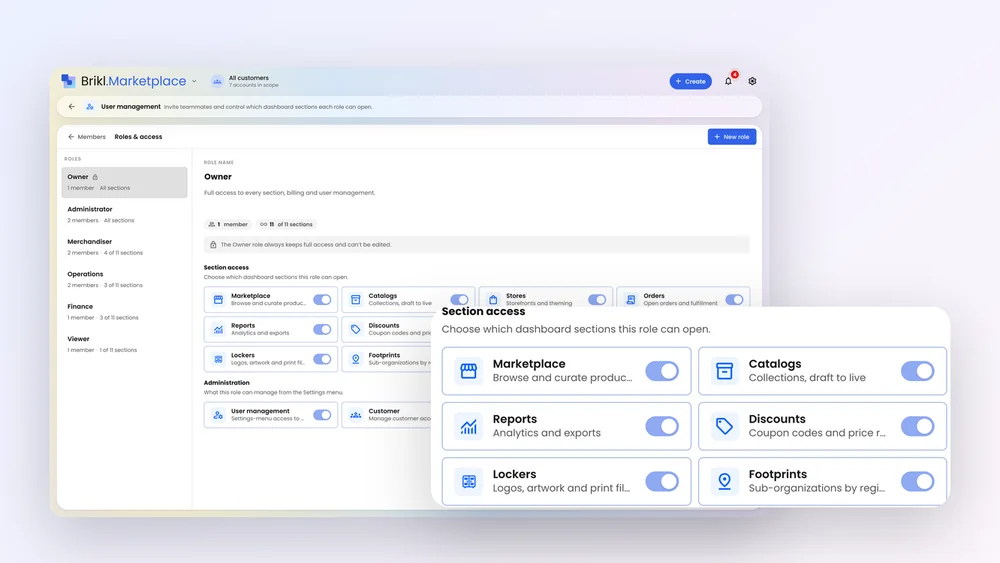
If you work with a partner, family member or junior rep, Brikl's roles let you share the dashboard. Default roles include Owner, Administrator, Merchandiser, Operations, Finance and Viewer, so each person sees only what their job needs.
How do you move your clients to on-demand stores?
Start with one client who trusts you, build their store, and use it as the example for the rest.
- Pick your first account. Choose a client who orders regularly and would welcome less admin — a team, a school, a business with staff uniforms.
- Build the store together. Brikl builds your first store with you in a live session at no charge, typically in 30–45 minutes, and trains you on the dashboard as you go.
- Show, don't explain. A live store says more than any pitch. Browse the Brikl showcase for examples to show clients.
- Move existing stores over. If you already run stores on another platform, Brikl recreates them at no charge under the Launch plan, so you can stop paying for the old one.
- Work through your book. Add one or two accounts a month. Each new store is another channel that keeps ordering without you.
Stores and bulk orders can sit side by side: Brikl's Order Builder lets you place the larger orders you handle today on demand, from the same dashboard.
Keep the accounts, lose the order desk
Open your first client store on Brikl with no inventory, no setup fee and no monthly subscription.
Frequently asked questions
Do I need to be tech-savvy to run on-demand stores?
No. Brikl builds your first store with you in a live session and trains you on the dashboard while you do it. After that, most of the work is choosing products and sharing a link. Order routing, payment and tracking run automatically.
Do I have to buy inventory or meet minimums?
No. Brikl has no minimum order quantity and sells products as single items. Each order is produced on demand, so you never pay for stock up front or store leftover boxes.
What does it cost to run stores on Brikl?
On the Launch plan, Brikl charges 3.5% per transaction, with no setup fee and no monthly subscription. Payment processing is separate, at 2.9% + $0.30 per transaction in the US. If a store has a quiet month, you pay nothing.
Can my clients earn money from their store too?
Yes. You can add a fundraiser to a store, so the client earns a share of every sale. It works well for schools, teams, clubs and nonprofits, and it gives the client a reason to promote the store themselves.
Can I keep doing bulk orders for clients who need them?
Yes. Stores and bulk orders can sit side by side. Brikl's Order Builder lets you place the larger orders you handle today on demand, from the same dashboard.
More from the blog

Growth
Coupons That Actually Move Merch
A coupon code is more than a discount — it's a reason to buy now. Here's how to use percentage and fixed-amount coupons to launch drops, reward audiences, and clear seasonal merch.

Growth
Why Personalization Matters for Promotional Product Distributors
Team stores, corporate programs, and school spirit shops all share one need: every item should feel like it belongs to the person wearing it. Without built-in personalization, distributors lose hours to spreadsheets, typos, and re-keyed orders. Here's why personalization belongs inside the product on Brikl, not in an inbox.
Growth
The Fastest Way to Launch On-Demand Stores
From blank page to live, branded storefront in roughly 22 minutes — without inventory, without bulk minimums, and without writing a single line of code.