



BlogIndustry
We Standardized the Catalog. Now We Need to Standardize the Order.
Supplier feeds carry the style, the color and the price. The decoration half of the order still arrives by email, one order at a time. At GXN in Kitzbühel, we talked about who fills that gap, and what it would take to close it.

Alistair Mylchreest (Sourcing City), Caleb Gilbertson (Imprint Engine) and Maarten Boone (Brikl) on stage in Kitzbühel. Photo: GXN
On October 8, 2026, I joined Alistair Mylchreest of Sourcing City and Caleb Gilbertson of Imprint Engine on stage at the GXN Annual Conference in Kitzbühel, Austria, for a session called Drowning in Data, Starved of Insights. Alistair has written it up for Sourcing City News.
 As seen in Sourcing City News
Mountains of data and the five percent that's broken
Alistair Mylchreest · October 13, 2026 · Photo: GXN
This was the fifth annual conference of the Global Executive Network, and it brought leaders from across the promotional products industry to the Grand Tirolia in Kitzbühel. Around a hundred people were in the room, from both sides of the Atlantic: suppliers, distributors, platforms and the associations that hold this industry together.
Alistair opened by saying that "mountains of data" might describe our industry better than "drowning". He's right. We have never had more product data moving between companies, through feeds, portals, APIs and spreadsheets. And we still struggle to turn it into orders without someone picking up the phone or opening their inbox.
I opened the session with a short keynote. Alistair then put questions to Caleb and me from the stage, before opening it up to the room. His first question to me, before I had even started, was whether I promised not to talk about AI. I didn't make that promise. But I did try to show why AI is the last part of the answer, not the first.
In short
- Supplier feeds in promotional products, in the US and in Europe, carry the product (style, color, sizes, material, price) but not the decoration: technique, print location and size, artwork and production file.
- That missing half is filled in by people, by email, one order at a time. It is where automation stops, and AI cannot reliably fill the gap.
- The US industry has standardized the connection between suppliers and distributors. The next step is standardizing the data itself, with one supplier-owned record that every partner can read.
- Nobody should own that standard. It should be open, with associations helping the industry agree on a shared vocabulary.
What decoration data is missing from supplier feeds?
Branded merchandise has a simple economic truth at its core: the blank product is a commodity, and the decoration is what the customer pays for. A plain hoodie is available from dozens of sources. A hoodie with the right logo, in the right place, in the right colors, is what wins the order and carries the margin.
Yet that is exactly the information our data leaves out. Supplier feeds have improved a great deal, especially in the US, and the industry deserves credit for that. A US distributor can now usually count on receiving the style, the colors, the size range, the material and the price; in Europe, even that is less consistent. What rarely arrives, on either side of the Atlantic, is everything needed to decorate the product: the available techniques, the print locations and their dimensions, the artwork requirements and the production file. In practice, half of every order is missing before anyone has started working on it.
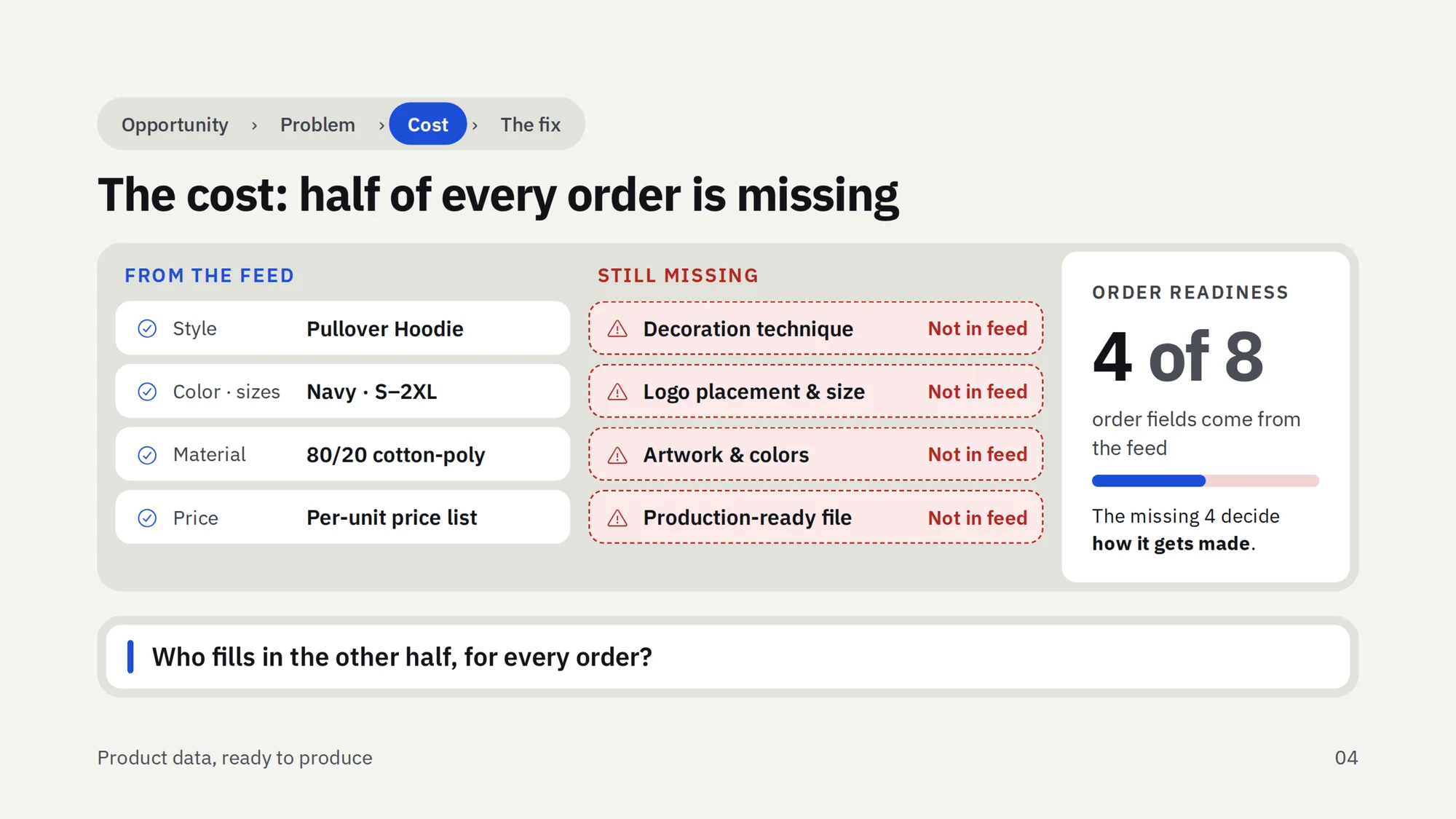
Four of eight order fields come from the feed. The missing four decide how the product gets made.
That gap does not disappear. It gets filled by people: account managers, customer service reps and art departments, working through it one email at a time. It is the most expensive way to complete an order, and it is the point where every attempt at automation stalls. AI does not change that. A model asked to complete missing decoration data will produce an answer, but it will be a guess, and a confident guess is worse than an honest blank.
"We're not talking about standardizing the connection. We're talking about standardizing the data."
How does product data become a producible order?
Most of the industry's data work so far, particularly in the US, has gone into consistency, and rightly so. When one supplier calls a color "Navy" and another calls it "Dark Blue", no system can tell whether they mean the same thing. The cure is unglamorous: one name per color, one size scale, print areas as named locations with real dimensions, and decoration techniques chosen from a defined list rather than typed into a text box. Free text can't be validated, so it can't be trusted.
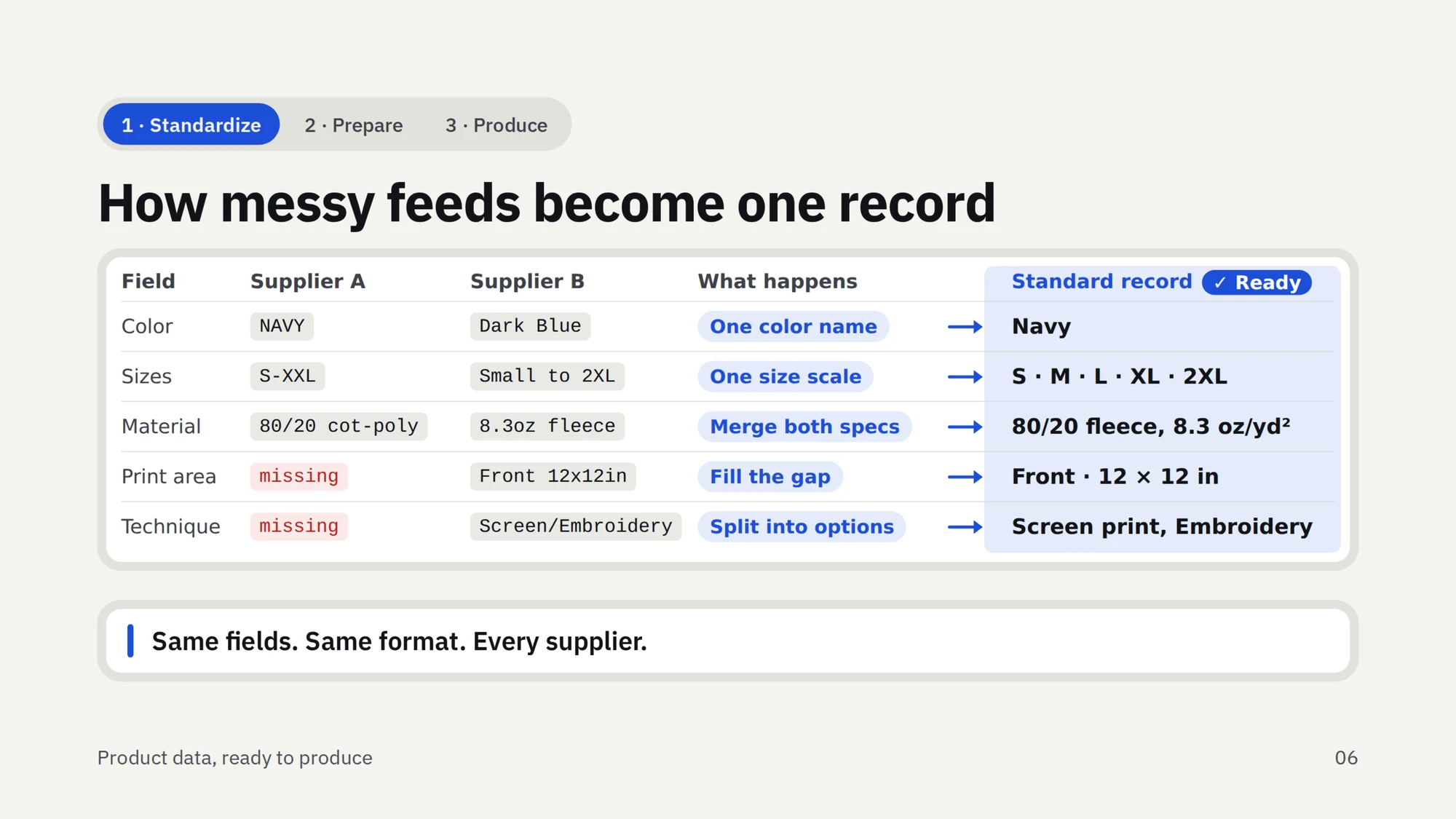
Same fields, same format, every supplier.
But clean data on its own does not make money. A perfect product record sitting in a database earns nothing until it becomes an order that a decorator can actually run. Between those two points sits a step the industry rarely talks about: preparing the decoration.
Every technique has its own requirements, and none of them are secret. Screen print needs vector artwork and spot colors. Embroidery needs a digitized stitch file. Digital print needs high-resolution artwork at the final print size. Even quantity can change the answer, when a small run goes digital and a large run of the same design goes to screen print. Every decorator knows this. The problem is timing: we ask for it after the order is placed, usually by email, when every missing detail costs a day.
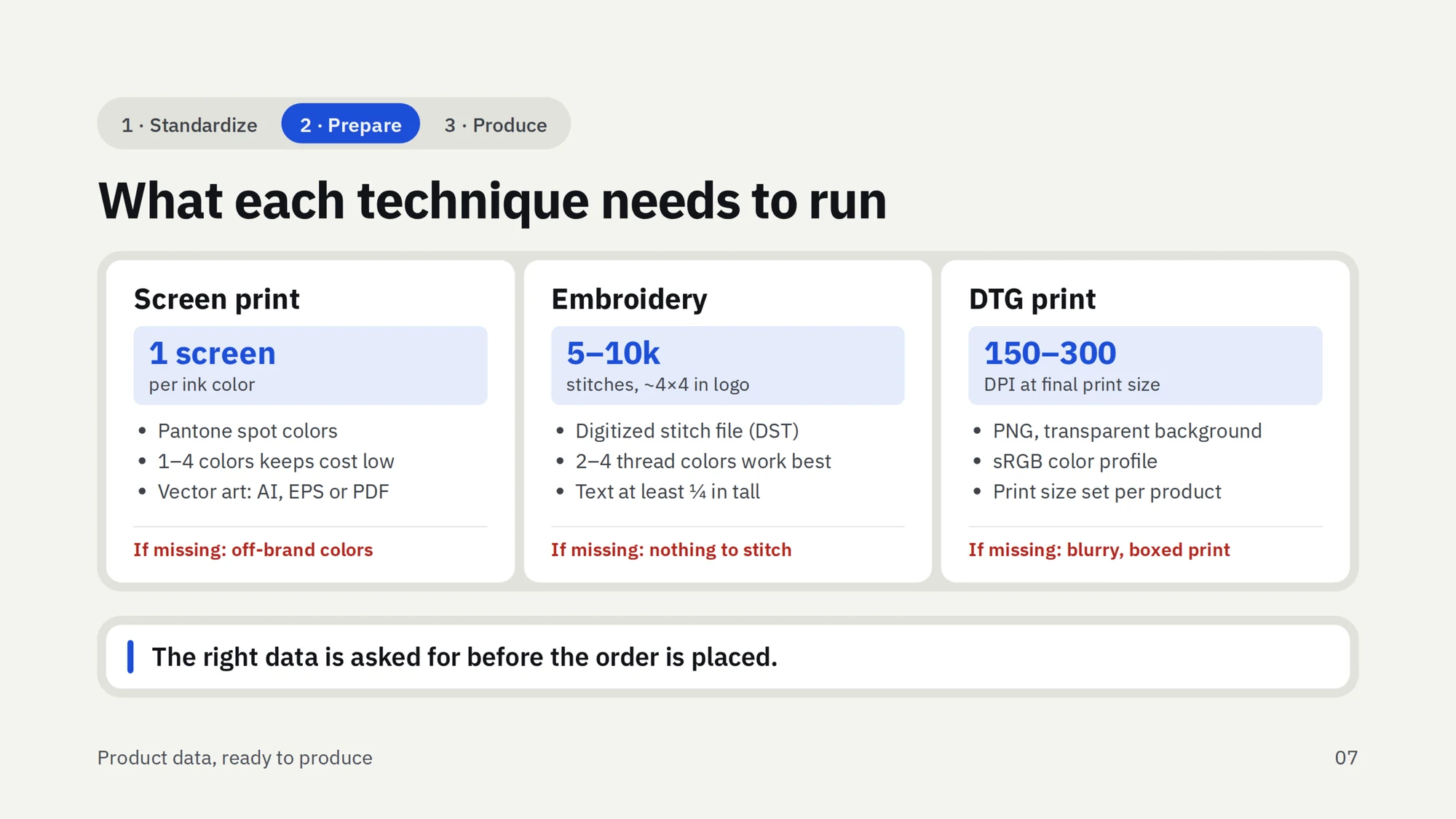
None of this is new to a decorator. What changes is when we ask for it.
If the product record knows which techniques it supports, and each technique knows what it needs, the right question can be asked while the order is still being built. The result is an order the decorator can produce without going back to anyone: a complete tech pack instead of a starting point for a conversation. Standardizing the data, preparing the decoration and handing over something production-ready are three separate steps. Only the last one turns data into revenue.
One record, read by everyone
The model I put forward in Kitzbühel is deliberately simple: one record per product, owned and maintained by the supplier, holding both the product data and its decoration setup. Every partner reads from that record, through whatever connection it already uses.

One supplier-owned record, readable by every partner.
It is worth being precise about what this is not. It is not a platform in the middle, and it is not one company holding the keys. It is closer to the opposite: a shared definition of what a complete product record contains, so that the supplier's own data can be read the same way by every distributor, platform and decorator.
Why this is hard, and worth it
Print on demand has already proven the principle, but inside a closed environment for thousands or tens of thousands of products. The promo industry is a different scale altogether, with probably more than a million products on each side of the Atlantic, spread across thousands of companies. That is what makes the problem hard, and also what makes the payoff large. A spec changed once would reach every partner. A new supplier would be usable on day one, and a new distributor would cost a supplier almost nothing to onboard. Few people in our industry would miss the integration projects that this would make unnecessary.
AI fits into this picture, but at the end rather than the beginning. A friend summed it up for me in American football terms: you win on blocking and tackling, not on cheerleading. Good data is the blocking and tackling. AI only looks impressive once that work has been done.
Why AI-generated artwork needs good data
The panel quickly showed how practical this already is. Caleb's company uses AI to generate mockups and proofs, and his experience is that the hard part is not the image. Anyone can get a polished mockup out of a general-purpose AI tool in seconds. What is hard is a pixel-perfect proof of a real product, with the right decoration method, size and placement, and without an extra zipper or seam the actual garment doesn't have. That precision comes from data, not from the model.
A decorator in the audience raised the other side of the same problem. Customers increasingly arrive with AI-generated designs that simply cannot be produced. Caleb's answer was that the fix starts with suppliers: publish what you can do and the limits you work within, in a form distributors can use. A sales team that knows a product's real capabilities can generate artwork that is actually possible. One that doesn't is guessing on the customer's behalf.
Who should own a product data standard?
If the industry needs one shared definition of a complete product and a complete order, the next question is obvious: who should own it, and who should pay for it? Alistair put exactly that question to me. Suppliers, platforms or associations?
My answer is that nobody should own it. A standard should be protected by an open license and kept in the industry's hands. The supplier owns its data and makes it available. Platforms and service providers, including companies like ours, compete on what they build on top, and there will always be room for services that improve data quality further. Caleb went a step further and suggested that US associations such as PPAI and ASI could fund open-source work that helps everyone standardize. I agree with the spirit of that. The most valuable thing associations can do, in the US and in Europe, is bring the industry together around one shared vocabulary that works on both sides of the Atlantic: what counts as a print location, what counts as a decoration method, what a complete order contains. That vocabulary only has to hold where it matters, at the point an order goes to production. As someone in the audience rightly pointed out, distributors should stay free to market products in their own words.
The cost of waiting is going up
If any of this sounds like a long-term project, the panel gave several reasons it isn't. Caleb estimated that only about ten percent of his suppliers have good data flowing in and out, even in the US, where PromoStandards connects suppliers and distributors. And his team is already using AI to source products: taking a customer's intent, searching supplier data and grading what comes back. Suppliers whose data can be read and trusted will be the ones his sales teams reach for first. He also expects the payoff on his side to be time. Freed from chasing missing specs, his salespeople could spend far more of their day actually selling.
Europe is moving too. Caleb found European supplier data more fragmented than in the US when his company opened in Dublin, and Alistair described a market that still runs heavily on PDFs, even where wholesalers offer APIs. But an American supplier working in Europe told the room that the number of European distributors asking about integration jumped at PSI this year. He believes the region has passed an inflection point.
Thank you
My thanks to GXN for bringing the industry together, to Alistair for a well-prepared session, and to Caleb for a sharp and honest conversation.
Frequently asked questions
What decoration data is missing from supplier product feeds?
Supplier feeds usually include the style, colors, sizes, material and price. They rarely include the decoration technique, the print location and its dimensions, the artwork requirements and a production-ready file. That is the half of the order that decides how the product gets made.
What does it mean to standardize the data, not just the connection?
In the US, PromoStandards defines how suppliers and distributors exchange data; Europe has no equivalent yet. Standardizing the data means agreeing on what the content means: one name per color, one size scale, named print locations with dimensions, and decoration techniques chosen from a defined list instead of free text.
Who should own a product data standard in promotional products?
Nobody. A standard should be open and protected by an open license. Suppliers own their data and make it available, associations in the US and Europe help the industry agree on a shared vocabulary, and platforms and service providers compete on the services they build on top.
Can AI fill in missing decoration data?
No. AI can help clean and map existing data, such as color names or messy spreadsheets. It cannot invent a stitch file or know a supplier's real imprint area. When decoration data is missing, an AI tool will guess, and the guess is likely to be wrong.
Why does good product data matter more as distributors adopt AI?
Distributors are starting to use AI to source products, searching supplier data and grading what comes back. Suppliers whose data is complete and consistent are easier to find, quote and order from, so their products are more likely to be chosen.
More from the blog

Industry
A Thousand Suppliers, and About a Dozen Can Tell You Where the Order Is
We tried to solve order status for our largest distributor customers and failed. Working out why took us somewhere more useful than another integration: the industry has been standardizing the wrong layer.

Industry
Your Platform Should Meet You Inside the AI You Already Use
The third piece in this series. Intent only becomes a real interface if a platform's actual operations are reachable — and the open standard that makes that possible has already arrived.

Industry
AI as the New Interface — For Those Who Want It
For decades, using software meant learning where the buttons are. What changes when you can just say what you want — and why the screens still stay.