



Sublimation vs DTF: Which Is Better for Your Merch?
By the Brikl team · Guides · Published: · Last updated:
Neither method is better across the board. Sublimation wins on white and light polyester, all-over prints and coated drinkware. DTF wins almost everywhere else: cotton, blends, dark garments and mixed-fabric stores.
If you sell branded merch, you rarely have to choose just one. On Brikl, each product carries its own decoration method. One store can sell sublimated jerseys next to DTF hoodies, and every order is made on demand from a quantity of one.
In short
- Sublimation dyes the design into polyester. No feel, no cracking, but only on white or light polyester and coated hard goods.
- DTF presses a printed film onto the fabric. Works on cotton, polyester, nylon, blends and dark colors, with a slight feel.
- Pick sublimation for team jerseys, all-over prints, performance tees in white and drinkware.
- Pick DTF for cotton tees, dark hoodies, caps and anything where the garment color matters.
- On demand, both start at one unit, with no screens, no setup fees and no inventory.
How do sublimation and DTF work?
Both methods use heat and a printed transfer, which is why they get compared. What happens to the ink is completely different.
Sublimation prints the design in mirror image onto transfer paper with special dye ink. A heat press at about 400°F (200°C) turns the dye into a gas that bonds with polyester fibers or a polymer coating. The design becomes part of the material, so there is nothing sitting on top. Our sublimation guide covers the process step by step.
DTF (direct to film) prints the design onto a clear PET film, with a layer of white ink behind the colors. An adhesive powder is added and cured, and the film is heat-pressed onto the product and peeled away. The design is a thin, flexible layer bonded to the surface of the fabric. Our DTF guide goes into more detail.
The practical difference comes down to two things. Sublimation needs polyester to bond with, and it has no white ink. DTF brings its own white layer and its own adhesive, so it sticks to almost any fabric in any color.
Sublimation vs DTF: side by side
The table covers what usually decides it for branded merch: fabric, garment color, feel and product range.
| Property | Sublimation | DTF |
|---|---|---|
| Fabrics | Polyester and polyester-rich blends only | Cotton, polyester, nylon, blends, leather |
| Garment color | White or light only (no white ink) | Any color, including black |
| Feel | None: the ink is inside the fiber | Slight film you can feel, most on large solid areas |
| Durability | Excellent: won't crack, peel or fade | Very good, comparable to screen printing |
| Print area | Edge to edge on cut-and-sew (all-over print) | Placed prints: chest, back, sleeve, cap front |
| Hard goods | Coated mugs, tumblers, bottles, mousepads, signs | Mainly textiles and caps |
| Breathability | Fabric stays fully breathable | Large prints are less breathable |
| Colors | Full color, no cost per color | Full color, no cost per color |
| Production time on Brikl | 3–5 business days | 2–5 business days |
| Minimum on Brikl | 1 unit | 1 unit |
Production times come from our decoration methods guide. Most orders reach the buyer within 7–10 business days, decoration included.
Which is better for your merch?
Start from the product and its color, not from the method. Once you know what you are selling, the choice usually makes itself.
| You are selling | Best fit | Why |
|---|---|---|
| Team jerseys with names and numbers | Sublimation | Full-color, edge-to-edge designs that stay soft and breathable |
| White performance tees for a run or event | Sublimation | No feel on technical fabric, no cracking |
| Black or navy cotton tees and hoodies | DTF | Sublimation cannot print on cotton or dark colors |
| Colored polyester performance wear | DTF | Bright colors on dark polyester; ask for a sample to check for dye migration |
| Company store with mixed fabrics | DTF | One method across cotton, blends and polyester keeps the logo consistent |
| Caps with a full-color front logo | DTF | Prints on structured panels; embroidery is the other option |
| Mugs, tumblers and water bottles | Sublimation | Full-color wraps on coated white drinkware |
| All-over print shirts | Sublimation | DTF is a placed print and cannot cover seams |
For team and spiritwear stores, sublimation is the classic choice for jerseys. Add DTF for the cotton fan tees and dark hoodies that parents and supporters buy. See our sport apparel range.
For company and employee stores, DTF covers most of the catalog: t-shirts, hoodies and caps in brand colors. Sublimation adds drinkware and light performance wear for company runs.
For creators and promo programs, use both: DTF for apparel in any color, sublimation for drinkware and all-over designs.
Not sure about a fabric? Order one piece before you launch. Polyester can react to heat, and our polyester guide explains what to check.
Selling sublimated and DTF merch on demand with Brikl
You don't need a heat press, a DTF printer or a box of blanks to sell either method. Brikl is an on-demand platform, built for scale, where distributors and organizations run branded merch stores and bulk orders.
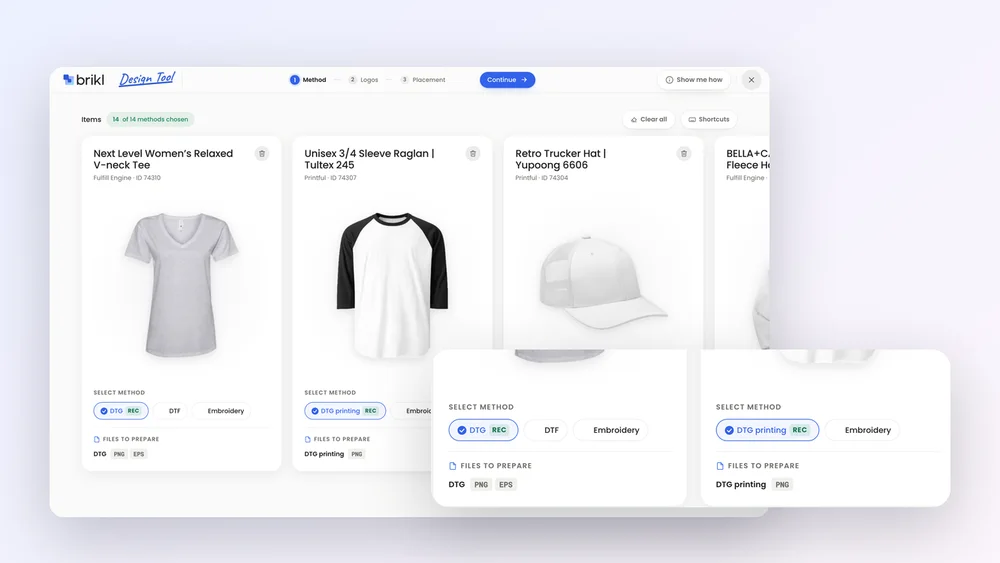
- Pick products, not machines. The product catalog holds 8,000+ products from 190+ brands. Each product shows which decoration methods it supports, from sublimation and DTF to embroidery and DTG.
- Upload your logo once. Drop in a PNG and instant digitization prepares it for production. The Design Tool places it on every product.
- Mix methods in one store. A store can sell sublimated jerseys, DTF hoodies and embroidered caps. At checkout, each item goes to a fulfillment partner that offers its method.
- Start from one. Every item is made after it is ordered and shipped straight to the buyer. No minimums, no inventory, no leftover sizes.
- Sample before you sell. Order a single piece through Order Builder, with costs shown in the catalog and no quote needed.
- Launch fast. Turbo Store builds a branded store from your organization type, a quality tier and your logo in about 10 seconds.
On the Launch plan, Brikl charges 3.5% per transaction, with no setup fee or subscription. Brikl is Merchant of Record, so payments and sales tax are handled for you. See how Brikl works.
Frequently asked questions
Is DTF better than sublimation?
Can you use DTF on polyester?
Can you sublimate on cotton or black shirts?
Which lasts longer, sublimation or DTF?
Which feels better to wear?
Is sublimation or DTF cheaper?
Can one store sell both sublimated and DTF products?
Is there a minimum order?
Sell both methods, without the equipment
Create a free account, pick your products and upload your logo. Your store can be live today, with sublimation and DTF in the same catalog and nothing to stock.