



What Is DTF Printing? A Guide to Selling DTF Merch on Demand
By the Brikl team · Guides · Published: · Last updated:
DTF (direct to film) printing puts your design onto a clear film, then heat-presses that film onto the product. The ink, a white base layer and an adhesive transfer as one thin layer. That is why DTF works on cotton, polyester, nylon, blends and leather, in light and dark colors.
For branded merch, that versatility is the point. One method can carry the same full-color logo across tees, hoodies, caps and performance wear. With on-demand production, you can sell DTF merch from a quantity of one, without buying a printer, a heat press or a single blank.
In short
- What it is: a printed film transfer, bonded to the fabric with heat and an adhesive powder.
- Works on: cotton, polyester, nylon, blends and leather, in any garment color.
- Best for: full-color logos on dark garments, mixed-fabric stores, performance wear and cap fronts.
- Watch out for: a slight feel on large solid areas, and dye migration on some dyed polyester.
- On Brikl: made on demand from one unit, 2–5 business days in production, no setup fees.
How does DTF printing work?
A DTF print goes through five steps. In on-demand production, the decorator runs them after each order comes in.
- Print the film. A DTF printer prints the design in color onto a clear PET film, then lays white ink behind it. The white layer makes colors bright on dark fabric.
- Add the adhesive. While the ink is wet, the film is coated with a hot-melt adhesive powder. The excess is shaken off, so powder only sits on the ink.
- Cure the transfer. Heat melts the powder into a smooth glue layer. The transfer is now ready to apply, or to store for later.
- Press it onto the product. A heat press bonds the transfer to the garment, typically at around 300–320°F (150–160°C) for 10–15 seconds.
- Peel and finish. The film is peeled away, leaving only the design. Many decorators press once more to set the print.
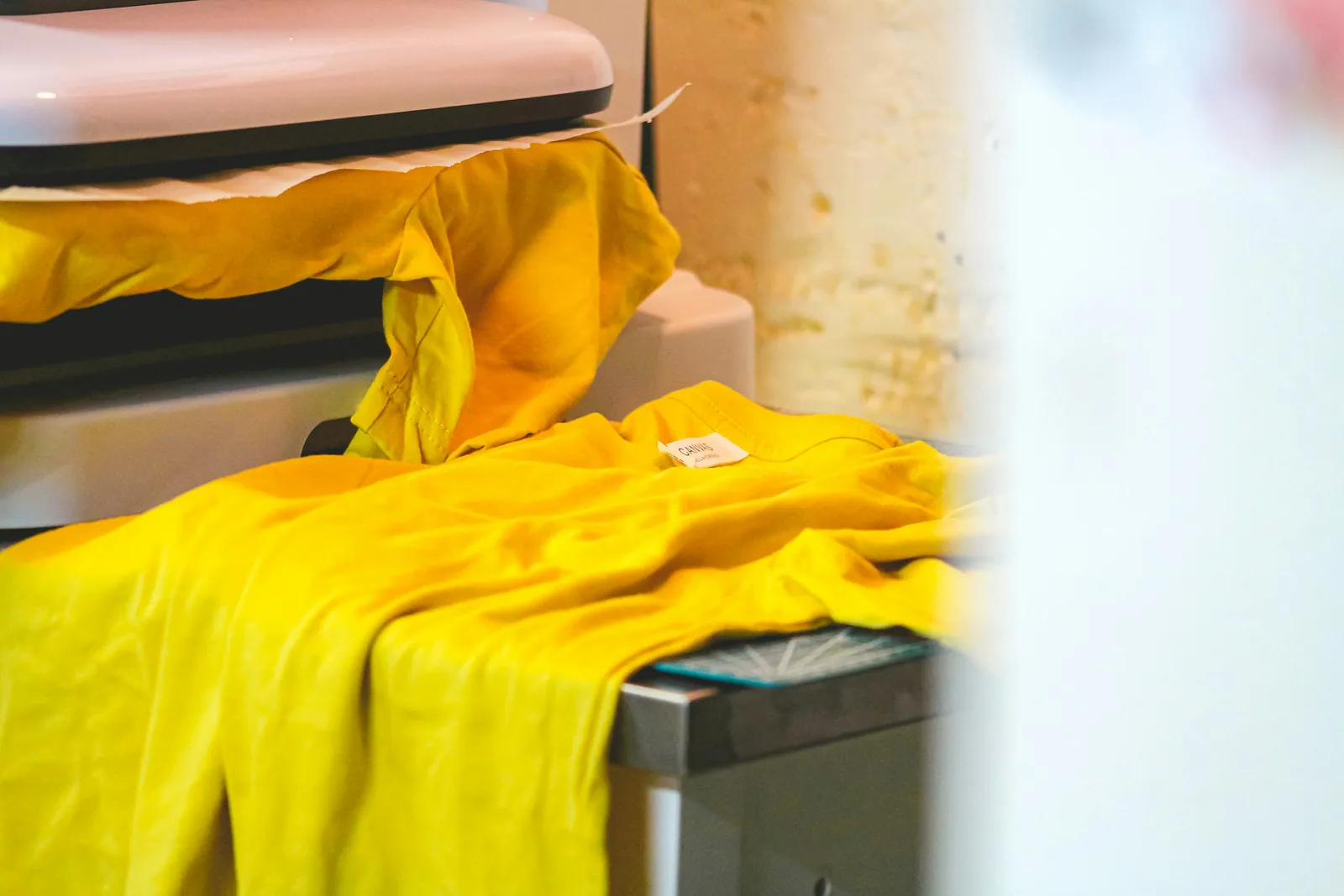
The film does the hard work. Because the design is printed on film and not on the garment, there are no screens, no color separations and no pretreatment. That keeps the cost per piece the same whether you order one or fifty.
Advantages and limitations of DTF for branded merch
DTF is the most flexible print method for on-demand merch. It also has trade-offs worth knowing before you build a store around it.
Advantages
- Any fabric. Cotton, polyester, nylon, blends and leather, so one logo works across a whole catalog.
- Any color. The white base keeps colors bright on black, navy and other dark garments.
- Full color at no extra cost. Gradients, photos and detailed logos cost the same as a one-color mark.
- Durable. Very good wash resistance, comparable to screen printing.
- No setup. No screens or pretreatment, so a single piece is as practical as a bulk order.
- Sharp detail. Fine lines and small text hold up well.
Limitations
- You can feel it. DTF is a thin layer on top of the fabric. Large solid areas feel heavier and breathe less than DTG or sublimation.
- Some shine. Prints can have a slight sheen, depending on the film and finish.
- Dye migration on polyester. Some dyed polyester bleeds into the print under heat. Test colored performance wear first.
- Not for all-over prints. DTF is a placed print. For edge-to-edge designs on polyester, use sublimation.
- Care matters. Wash inside out, skip high heat and don't iron the print directly.
What products work best with DTF?
DTF shines wherever the garment color or fabric would rule out other methods. Each product page on Brikl shows which methods that style supports.
| Product | Why DTF works | Good alternative |
|---|---|---|
| Dark cotton tees | Bright full color on black and navy | DTG for a softer feel |
| Hoodies and crewnecks | Holds up on thick fleece, any color | Embroidery for a premium look |
| Polyester performance wear | Prints on technical fabric in any color | Sublimation on white polyester |
| Caps | Full-color front panels | Embroidery, the classic cap finish |
| Tote bags and canvas | Sharp logos on heavy cotton | Screen printing in bulk |
| Workwear and outerwear | Bonds to nylon and blends | Embroidery |
Browse custom t-shirts, hoodies and headwear to see the styles available with DTF. Testing a stretchy or dyed polyester? Our polyester guide explains what to check in a sample.
Design tips for DTF artwork
Good DTF prints start with the file. These habits keep logos sharp and comfortable to wear.
- Use a transparent PNG at 300 DPI, sized at the print size. Anything that isn't transparent gets printed, including white backgrounds.
- Avoid semi-transparent pixels. Soft shadows and glows print as a faint haze. Use solid colors or a halftone effect instead.
- Break up large solid areas. Knockouts, distressing or halftones reduce the film's weight, so the print feels lighter and breathes better.
- Keep fine lines above about 1 pt. Very thin strokes can lift or break in the wash.
- Check small text. DTF handles detail well, but text under about 6 pt is hard to read on fabric.
- Order a sample on any new garment, especially colored polyester, before you launch.
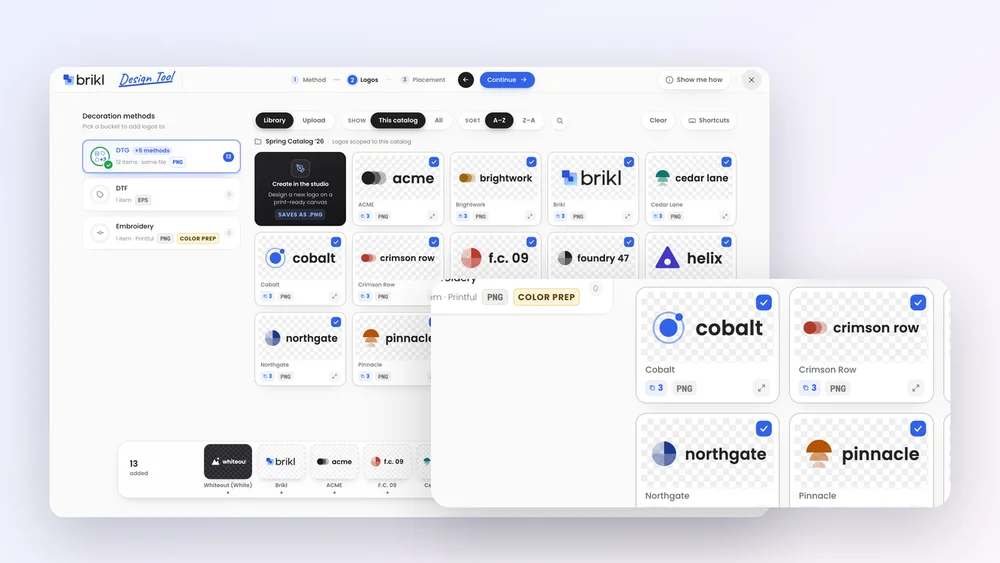
On Brikl, you upload your logo as a PNG and instant digitization prepares it for each product's decoration method. The Design Tool warns you if the resolution is too low for the print size.
Selling DTF merch on demand with Brikl
A DTF setup means a printer, a powder shaker, a curing unit, a heat press and a shelf of blanks in every size. With on-demand production, you skip all of it. Brikl is an on-demand platform, built for scale, where distributors and organizations run branded merch stores and bulk orders.
- Choose DTF products from 8,000+ products and 190+ brands in the catalog. Each product shows its decoration methods and cost.
- Upload your logo once. Brikl prepares it for DTF and every other method in your store.
- Launch a store in about 10 seconds with Turbo Store, or place a bulk order with Order Builder.
- Sell from one unit. Each order is printed, pressed and shipped to the buyer by a fulfillment partner. Production takes 2–5 business days, and most orders arrive within 7–10.
- Mix methods freely. Put DTF hoodies next to embroidered caps and sublimated drinkware. Orders split automatically at checkout.
- Keep the margin. You set the price. On the Launch plan, Brikl charges 3.5% per transaction, with no setup fee or subscription, and handles payment and sales tax as Merchant of Record.
No inventory, no minimums and no leftover sizes after the order window closes. See how Brikl works.
Frequently asked questions
What does DTF stand for?
How long does DTF printing last?
Does DTF crack or peel?
Can you DTF print on polyester?
Is DTF better than DTG?
Is DTF better than sublimation?
Is there a minimum order for DTF on Brikl?
How fast is DTF merch delivered?
Sell DTF merch without the equipment
Create a free account, pick your DTF products and upload your logo. Your branded store can be live today, with nothing to stock and no minimums.