



What Is DTG Printing? A Guide to Selling DTG Merch on Demand
By the Brikl team · Guides · Published: · Last updated:
DTG (direct to garment) printing works like an inkjet printer for clothing. It sprays water-based ink straight onto the fabric, where it soaks into the fibers. The result is a soft, full-color print that you barely feel, at its best on 100% cotton.
For branded merch, DTG is the go-to method for detailed, colorful designs in small quantities. There are no screens to make and no setup per design, so one shirt costs about the same to print as fifty. With on-demand production, you can sell DTG merch from a quantity of one, without a printer or a stack of blanks.
In short
- What it is: water-based ink printed directly into the garment, then heat-cured.
- Works on: 100% cotton best; cotton-rich blends work with slightly softer colors.
- Best for: full-color, photographic and detailed designs on tees, hoodies and totes.
- Watch out for: weaker results on polyester, and extra cost for the white underbase on dark garments.
- On Brikl: made on demand from one unit, 2–5 business days in production, no setup fees.
How does DTG printing work?
A DTG print takes four steps. In on-demand production, the decorator runs them after each order comes in.
- Pretreat (dark garments). Dark and colored garments get a pretreatment spray, which helps the white ink bond and stay bright. White garments usually skip this step.
- Load the garment. The shirt is flattened onto a platen, so the print area is smooth and lined up.
- Print. The printer lays down a white underbase on dark fabric, then prints the full-color design on top. On white garments, it prints the colors straight onto the fabric.
- Cure. A heat press or tunnel dryer sets the ink, so it survives washing.
The design goes from file to fabric with no screens or separations. That is why DTG works for a single personalized shirt as well as a run of fifty.
Advantages and limitations of DTG for branded merch
DTG gives the softest full-color print on cotton. It is less forgiving on synthetics and dark colors.
Advantages
- Soft hand. The ink sits in the fibers, so prints feel like part of the shirt, especially on light garments.
- Unlimited colors. Photos, gradients and detailed artwork cost the same as a simple logo.
- No setup. No screens or film, so one piece is as practical as a bulk order.
- Great for personalization. Every shirt can carry a different name or design.
- Breathable. Even large prints stay comfortable on light garments.
Limitations
- Cotton first. DTG works best on 100% cotton. Blends print with duller colors, and polyester is a poor fit.
- Dark garments cost more. They need pretreatment and a white underbase, which adds cost and makes the print slightly heavier.
- Durability. Good for about 30–50 washes with proper care, less than screen printing at high wash counts.
- Not for bright neon or metallic effects. DTG prints in standard process colors.
- Pretreatment marks. A faint square can show on dark garments after printing; it usually fades after the first wash.
What products and fabrics work best with DTG?
The smoother and more cotton-rich the fabric, the better DTG looks. Ring-spun 100% cotton gives the sharpest, brightest prints.
| Fabric | DTG result | Better option if it falls short |
|---|---|---|
| 100% ring-spun cotton | Excellent: sharp, bright and soft | — |
| Cotton-rich blends (e.g. 60/40) | Good, slightly softer colors | DTF for brighter color |
| Tri-blends | Vintage, faded look | DTF if you need full color |
| 100% polyester | Poor: ink doesn't bond well | DTF, or sublimation on white |
| Fleece (cotton-rich) | Good on the outer face | Embroidery for a premium look |
Popular DTG products include staple and premium tees, long sleeves, hoodies, crewnecks and cotton totes. On Brikl, you'll find tees from brands like Bella+Canvas, AS Colour, Gildan and Next Level. Browse custom t-shirts and hoodies; each product page lists the methods it supports.
Design tips for DTG artwork
DTG reproduces almost anything you can put on screen. These habits keep the print looking the way you designed it.
- Use a transparent PNG at 300 DPI, at the actual print size. Low-resolution files print soft or pixelated.
- Remove backgrounds. A white box behind your logo prints as a white box, and on dark shirts it becomes a heavy patch of white ink.
- Avoid semi-transparent effects on dark garments. Soft shadows and fades print over the white underbase and can look muddy. Use solid colors or halftones.
- Design for the garment color. Colors print brightest on white and light shirts. On dark shirts, check contrast and skip very dark colors that disappear into the fabric.
- Expect some color shift. Screen colors and fabric colors never match exactly. Order a sample for brand-critical colors.
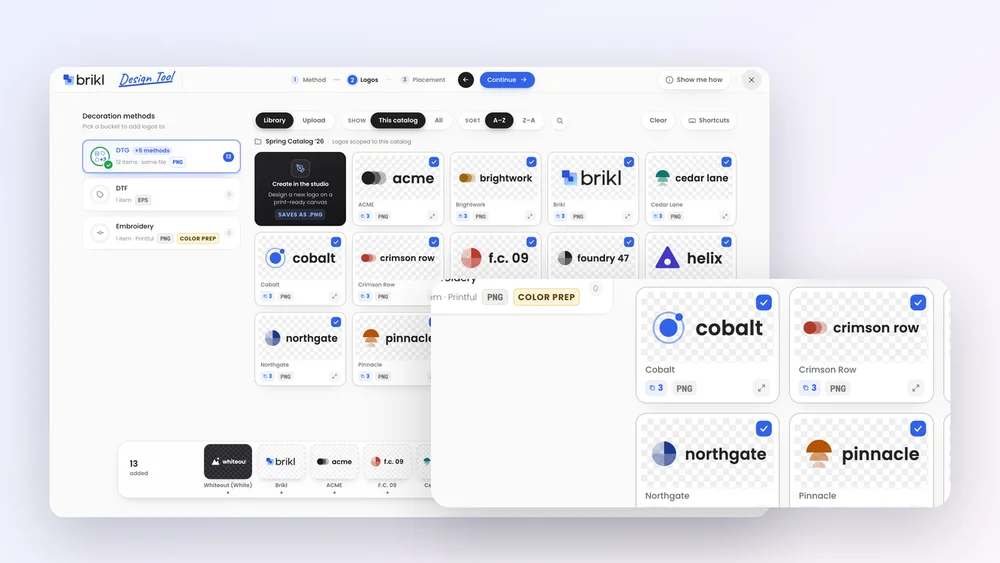
On Brikl, you upload your logo as a PNG and instant digitization prepares it for each product's decoration method. The Design Tool warns you if the resolution is too low for the print size.
DTG vs DTF vs screen printing
DTG and DTF are the two on-demand print methods for apparel. Screen printing is the bulk classic. Here is how they compare for branded merch.
| Property | DTG | DTF | Screen printing |
|---|---|---|---|
| Best fabrics | 100% cotton | Cotton, polyester, nylon, blends | Cotton and cotton-poly blends |
| Feel | Softest, ink in the fibers | Thin layer on top | Ink layer, soft with water-based inks |
| Colors | Unlimited, photo quality | Unlimited, photo quality | 1–6 spot colors, cost per color |
| Dark garments | Yes, with pretreatment and white underbase | Yes, built-in white layer | Yes |
| Durability | Good, about 30–50 washes | Very good | Excellent, 50+ washes |
| Minimum | 1 unit | 1 unit | Traditionally 24+ units |
| Setup | None | None | Screen per color |
| Cheapest when | Small runs, many designs | Small runs, mixed fabrics | Large runs of one simple design |
Choose DTG for soft, detailed, full-color prints on cotton. Choose DTF for polyester, dark garments and mixed fabrics; see our DTF guide. Choose screen printing when you order a large run of one simple design up front. For a deeper comparison, read Screen Printing vs. Embroidery vs. DTG or the full decoration methods guide.
Selling DTG merch on demand with Brikl
A commercial DTG printer, a pretreatment machine and a curing press cost tens of thousands of dollars before you print a single shirt. With on-demand production, you don't need any of them. Brikl is an on-demand platform, built for scale, where distributors and organizations run branded merch stores and bulk orders.
- Choose DTG products from 8,000+ products and 190+ brands in the catalog, with the cost of each product shown up front.
- Upload your logo once. Brikl prepares it for DTG and every other method in your store.
- Launch a store in about 10 seconds with Turbo Store, or place a bulk order with Order Builder.
- Personalize every piece. Shoppers can add names or text, previewed live before they buy. DTG prints each one individually at no extra setup.
- Sell from one unit. Each order is printed and shipped to the buyer by a fulfillment partner. Production takes 2–5 business days, and most orders arrive within 7–10.
- Keep the margin. You set the price. On the Launch plan, Brikl charges 3.5% per transaction, with no setup fee or subscription, and handles payment and sales tax as Merchant of Record.
No inventory, no minimums and no boxes of unsold shirts. See how Brikl works.
Frequently asked questions
What does DTG stand for?
How long does DTG printing last?
Can you DTG print on polyester?
Can you DTG print on black shirts?
Is DTG or DTF better?
Is DTG cheaper than screen printing?
Is there a minimum order for DTG on Brikl?
How fast is DTG merch delivered?
Sell DTG merch without the equipment
Create a free account, pick your DTG products and upload your logo. Your branded store can be live today, with nothing to stock and no minimums.